Friday, July 10, 2026

Artificial Intelligence Tech! You are just not on the menu today

Picture this. You used to pay for a grammar app. Then Large Language Models (LLMs) showed up, and one day you realized you hadn't opened that app in months. You didn't even cancel it like a responsible adult. You just ghosted, yah, we all did. No breakup text, nothing. You just bounced. And here is the part that should worry every one of us building AI products today. That grammar app did nothing wrong. It just stopped being needed, which is honestly a worse way to go out of business than being bad at your job.

Rewind a bit. Remember the old internet, back when every task had its own website and every website did exactly one job? One site for translation. One for grammar. One for sentiment analysis. A whole Q/A forum, people could ask questions and other strangers could argue about the answer … hahaha. A calendar app that only did calendars, as if that was a full time job. Search, video, and email were separate kingdoms with their own logins, their own passwords you forgot, and their own “forgot password” emails clogging your inbox. That made sense back then. Building software was hard, so everyone picked one lane, stayed in it, and called it a business model.

Today, one model can translate, write, check your grammar, summarize your meeting, chat with you at 2am. LLMs today make video, music, voice, and full presentations, basically doing the job of five different subscriptions you forgot you were still paying for. This is not a small upgrade. It is a different game, and most of us are still playing by the old rules like it's 2015. That some refuse to use AI, just because you cant see it doesn’t mean you arent using it -hahaha.

This is already showing up in real numbers, not just vibes and hot takes. Jasper AI hit a 1.5 billion dollar valuation as an AI writing tool. Then the big models added the same writing features for free, and Jasper's revenue roughly cut in half, which is the corporate version of watching your date check their phone. Otter and other meeting note apps built entire businesses around summarizing calls. Then Zoom, Teams, and Google Meet quietly added the same summaries right inside the tools people were already using anyway. Nobody stole those companies' lunch on purpose. The bigger platform just added a button, and the smaller app quietly lost its reason to exist, like a middle child nobody remembers to invite anymore.

Let's look at the “creatives” space. A few years ago, producing a track meant paying for a beat licensing platform, hiring a freelancer on Fiverr for mixing, and maybe using a separate app for lyric generation. Now? Multimodal AI doesn't just read and write, it listens, composes, and produces. You can prompt a model to generate the lyrics, compose the backing track, and master the audio all in the same browser tab. The “one app, one format” business model is being obliterated in real time. If your entire startup relies on being just one isolated step in a user's creative pipeline, a generalized AI model is going to swallow that pipeline whole. What used to be a fragmented, five subscription workflow is now just a Tuesday afternoon inside a single text box.

Right now, a lot of small AI builders are still alive simply because the big “guns” have not gotten around to them yet. Not because anyone is protected. You are just not on the menu today. Check back tomorrow. And these big labs keep adding more “experts” and “agents” for music, teaching, coding, writing, image editing, basically assembling an entire office of imaginary employees inside one app. Every new expert they add is a category that used to be somebody's entire company and somebody's entire personality on LinkedIn.

So here is my simple thought, free of charge. If a big AI company added your exact feature for free next month, would your users leave you the next day? If yes, congratulations, you are not running a company. You are running an unpaid focus group for a feature they have not shipped yet. So what actually protects you? Not your prompt, that is for sure. Anyone can copy a prompt in an afternoon, over lunch, without even finishing their kikomando. What protects you is what only you know. Your own data. Your own workflow. The kind of knowledge that lives in your head and in your customers' habits, not in some public dataset a model was trained on somewhere in a data center you will never see.

Now, this is not a call to go full and try to train a million-billion parameter model in your company hideout. You don't have to build the engine from scratch. Leverage the open source ecosystem, build on top of models like Llama or Mistral to keep your options open and avoid vendor lock-in. But guard your proprietary workflow with your life. The fine-tuned data loops, the hyper-specific user habits you capture, your seamless integration into a niche, messy legacy industry, that is your actual trade secret. Your core IP should never sit as plain text in the API logs of the very mega-corp whose model you are building on top of. That is not paranoia. That is just reading the room. Open source models belong to everyone, but your competitive edge is not a gift you hand out.

Look at the current tech, and here is the future I see. Almost every major product today, email, video platforms, spreadsheets, presentation tools, has quietly plugged in its own LLM, like everyone showed up to the same party wearing the same outfit and pretending it was a coincidence. Each company is racing to build its own smart assistant inside its own product. But that is just the middle step, a costume change before the real show. The direction is obvious. All these separate LLMs bolted onto separate products are slowly merging into one place. Soon you will load a single LLM and, from that one spot, reach your email, your calendar, your documents, your spreadsheets, your videos, your music, everything you currently visit ten different sites/LLMs and remember ten different passwords for.

So if you are building something today, do not build the button. Everyone can build a button, and someone with more money than you will build a shinier one next quarter. Build the thing a giant company genuinely cannot copy overnight, your data, your relationships, your specific way of solving one real problem for real people. The tide is coming in fast, and thin ideas float away first. Don't let yours be one of them.


Thursday, February 23, 2023

Natural Language Procession (NLP)

What is Natural Language Processing (NLP)?

NLP is a computer science and artificial intelligence subfield focusing on interactions between computers and human language. NLP aims to enable computers to understand, interpret, and generate natural language to perform various tasks, such as language translation, sentiment analysis, text summarization, question answering, and more.

NLP involves a combination of techniques from computer science, linguistics, and machine learning. These techniques include text preprocessing (such as tokenization, part-of-speech tagging, and syntactic parsing), statistical modeling, neural networks, and other machine learning algorithms.

One of the main challenges in NLP is the ambiguity and complexity of human language. Natural language is full of nuances, idioms, slang, and other elements that make it difficult for computers to understand and process. Researchers in NLP aims to develop models and algorithms that can handle these challenges and accurately capture the meaning and intent behind human language.

Learn More>>https://kimrichies.blogspot.com/p/natural-language-processing-nlp.html


Wednesday, November 21, 2018

Running a C-Program using the Command prompt on Windows

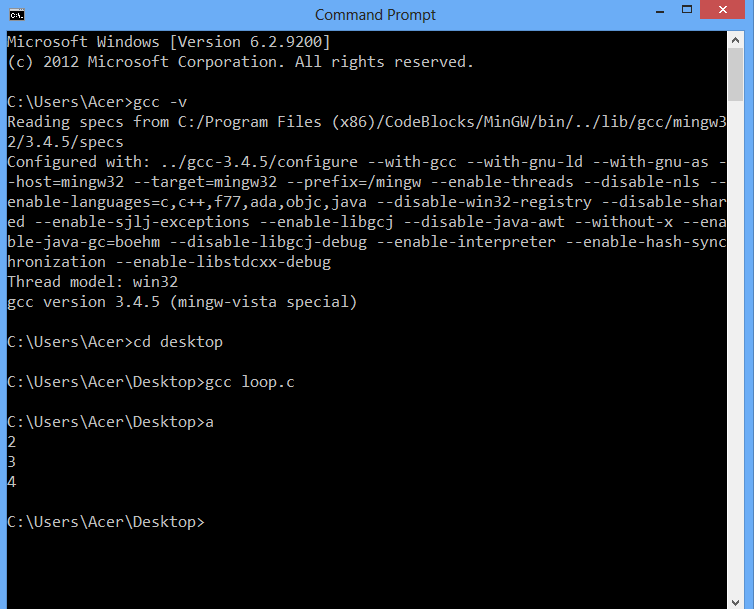
Make sure you have a compiler installed, for my case i used GCC. Usually, if its not installed, when you type the command "gcc -v" on the command line,  you will get an error "gcc is not recognised as an internal or external command".  If you get this error, even after installing the program, then try setting the environment variables as bellow;

  • Open control panel
  • Type "environment"
  • Click to open "Edit the system environment variables for your account"
  • Select PATH,  then Edit
  • In the edit section of variable value, add the path where  your compiler is stored right after the termination (;)
    • The path where your gcc compiler could be located in the directory "C:\MinGW\bin" or according to your customised path.
    • On mine, since i had installed code blocks, its location was C:\Program Files (86)\CodeBlocks\MinGW\bi
Write your program in any editor for example Notepad, save it with a .c extension. I stored mine on the desktop
  • Open the command Line/Prompt
  • Type "cd desktop" if your program is stored on the desktop Or navigate to the directory where your program is stored
  • Type: gcc <fileName.c > e,g gcc loop.c This will compile your code and produce an executable with a name e.g a.exe because we never specified the name of our executable. 

    • You can name your file by following this structure; gcc -o <name_of_executable> <name_of_source_code
  • Run the program by typing the executable file name on your command line E.g "a" 
Here is the code i used


Bellow are the commands and the output


Friday, January 15, 2016

How much will your handle, an MB? GB? TB? PB......Geopbyte (GB)

During my childhood, I would travel to new places without using any technological equipment to store more routes, and I would make sure that I used my brain to store all the routes, especially by use of landmarks. Then came the technological revolution, as I articulate bellow

At first, when cell phones were introduced, the limited memory capacity would force someone to grasp at least the critical phone numbers, and of course, they had no Wi-Fi. Today, many people can not even store emergency contact numbers as smartphones have all kinds of support needed-apps, including voice recognition, sensors, etc.

The introduction of real-time GPS systems in cars revolutionized the transport system to the extent that, minus these systems, some people might need help tracing their way back to their homes. Cloud computing has provided information storage services that have made access to information omnichannel. Furthermore, we have moved into the establishment of smart cities that will decide on the way we utilize a cities resources for proper management; Internet of Things/Everything where even the smallest equipment can be connected online, robots, machine learning, and nano technologies are also some other aspects you could look at.


Information has become massive that it is now causing an overload not only to computers but also to humans. Today, some data - call it Big data can not be processed using conventional methods; a case in point is the information generated on social media and search platforms; it has called for more innovative ways of delivering information, a concept termed web 3.0/semantic web that uses ontological languages to make sense out the stored information. All this ensures that humans can store, process, query, or even think about handling information-related issues.

What about the security of our information? We are not only scared of information theft, as it might apply to information stored online, but also of information loss that might happen that - is not stored on any device. Do you trust your secondary storage devices- optical drives, tapes,  or your head?

People have been taking various drugs to help improve brain function and reduce the number of sleeping hours to improve their productivity. Some of these drugs have also been seen in many academic institutions where some students have run mad. In contrast, others have committed suicide due to the immense pressure to store and recall information when needed. Some drugs have been medically proven to be used to expand brain power.

Putting all this and more in mind, it makes me think that very soon, human beings will run on memory chips as a supplement, and humans will voluntarily accept the implants to cope with the competition and dynamics of this ever-changing life. This kind of human evolution may be called homo "sapiens smart sapiens" - historians will tell us when the time comes. If this happens, how much capacity will you be able to handle a Megabyte (MB)? Gigabyte (GB)? Tera Byte (TB)? Petabyte (PB)......or a Geopbyte (GB)? 

Thursday, October 8, 2015

Cloud Computing

Cloud computing is an online-based service that enables an individual or a company to access, store, and manage computing resources from anywhere at any time, delivered on demand. Forget about the different time zones or the expensive and complicated networking systems needed to handle your company's increasing amounts of data; cloud computing provides a platform where hardware is vitalized and accessed through user-friendly applications. 

The dynamism of IT is not only related to the technologies used but also the users as they demand divergent services; the providers of cloud services were able to identify this and categorized the services into three: Platform as a service (PaaS) - basically to provide user access to build and deploy applications, e.g., Google AppEngine, Infrastructure as a service (IaaS)- provision of virtual hardware e.g., CPU's, memory, secondary storage, and OS, and Software as a service (SaaS) - which enables a person or company to utilize application software's that suit there needs by performing functions like accounting, document management, customer relationship management, e.t.c. 

The company or individual can access cloud resources publicly through a shared channel, privately where the resources are only accessed by one company, and a hybrid of the two- where some actions are accessed through public channels. Still, more secure resources and information are accessed through a private channel.

With the current increase in data and on-demand services – not forgetting streaming services, cloud computing is a platform that has given rise to other computing advancements, including big data. 

Tuesday, September 22, 2015

Smartcity, Machine to Machine and Internet of things

Machine to machine , smartcity, internet of things(anything can be connected to the network). All these concepts have been developed to empower machine independency. I mean, they are really cool technologies. Imagine a situation where I can remotely monitor what is at my house to an extent that I can control my power and water usage (smart). Its also incredible for  a company manger to seat in his office and is able to monitor delivery trucks, customer preferences and actually fine tune content like advertisements basing on customer behavior and "smart" likes. A traffic system that adopts according to the present traffic, biometric authentication systems, big data analysis and so forth.

Countries are in a rush to set up the first complete smart city with South Korea leading the chase. But what does all this mean to Human beings ? Of course, there are lots of benefits as everyone desires confort or being their own bosses by commanding a system that will never have hard feelings or judge you. On the other hand, it would mean that if someone gained illegal access to any of these system, the damage might be catastrophic and for the most part, I don't know if it's going to creat more jobs, the answer to this is pretty obvious!

Do you think we still have a way out of this confinement of technology and innovations ? I dont think so! But I fancy the technologies no matter the setbacks, though we need to get thinking about how we will co-exist.  

Tuesday, August 26, 2014

China to develop own OS

By October, China might have its own Operating system to compete with the likes of Microsoft, Apple and Google. The operating will first be tested on computers and latter a mobile version will be developed. This also follows the recent ban of the use of Windows 8 on government computers.

I hope Africa will also be looking forward one day to develop its own operating system.
>>China to develop own OS